Testing methods and neural networks for faster and more accurate predictions
In this age of digitalisation and technological innovation, together with sustainability requirements, our technology centre is deepening its commitment to advanced research and sustainable development in order to create knowledge and feasible solutions.
Focused on this task, our team in the Sustainable Transport area of Polymers Technology is dedicated to unravelling the complexities of materials such as reinforced thermoplastics and thermoplastic elastomers (TPEs) by analysing their mechanical behaviour through advanced testing systems and combining deep neural networks or Deep Learning. Two distinct methodologies with a common purpose: to predict the mechanical behaviour of thermoplastic materials more quickly and accurately and to provide practical and durable solutions for the transport industry, ensuring optimal performance and prolonging the service life of polymeric materials.
Creep testing
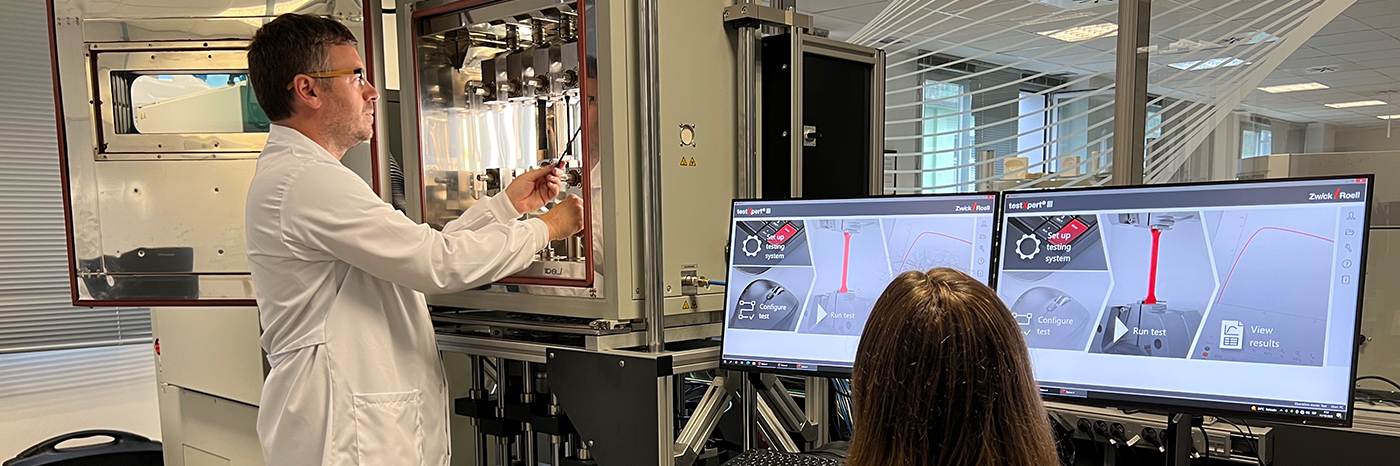
At Leartiker we replicate the real-life conditions under which these polymeric materials by using advanced testing systems, where we analyse changes and degradation of thermo-mechanical properties. For this purpose, we develop new acceleration methods that shorten run times without hindering our ability to predict the lifespan of materials and manufactured products. An example of this are the creep and stress relaxation tests by which we characterise polymeric materials over lon
Reinforced thermoplastics and TPEs are highly critical materials in this type of testing because of their sensitivity to the effects of stress, temperature or relative humidity in the environment in which they are used. Therefore, it is vital to obtain test data for subsequent use in the design of materials and products: creep curves (strain vs time for different stress, temperature and relative moisture levels), isochrone curves (stress vs strain curves for different times, temperatures and relative humidity) and isometric and stress relaxation curves (stress vs time curves for different strain, temperature and relative humidity levels).
This data can then be fit to physically meaningful models to enable finite element calculations to be carried out on further injection-moulded components.
We are generating knowledge in this field by developing internal and nationwide projects such as CRITERION, which aims to develop a new approval method for plastic materials and parts, which will reduce current testing times to days and weeks rather than months and years, as is usually the case in industry.
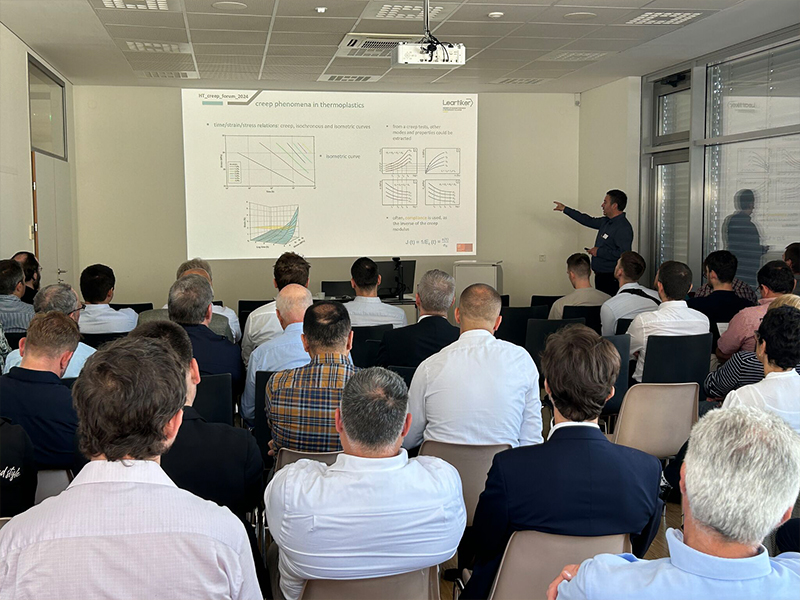
Specifically, we have just taken part in the ZwickRoell Forum for High-Temperature and Creep Testing, held in Austria, where we presented some case studies that were conducted at Leartiker comparing the results obtained in standardised tests over long periods of time (>1000 hours) with accelerated methods based on the time-temperature superposition principle. These results show a high degree of consistency between standardised and accelerated tests, meaning that tests can be run in significantly shorter times (8 hours compared to 1000 hours), which is highly positive. These results highlight the benefits of using this test acceleration methodology in material and product development phases in order to predict service life, due to the significant reduction in test run times.
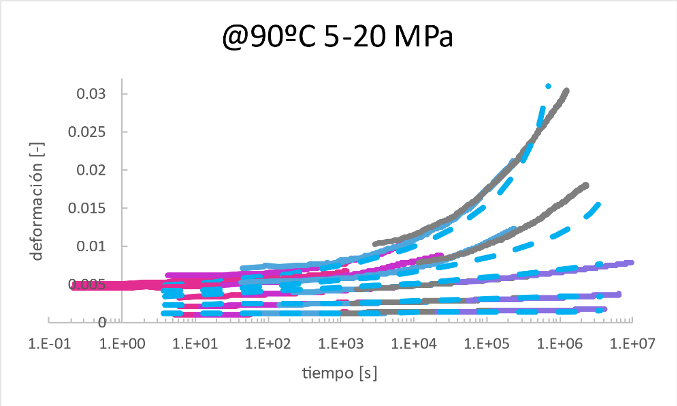
Pictured is a graph showing a polypropylene material reinforced with 30% short glass fibre. Comparison of creep curves obtained at 90ºC with different levels of stress applied in 1000-hour tests (dashed lines, standardised tests) and the master creep curves obtained by time-temperature superposition in accelerated tests (in solid lines) that were run for just 8 hours.
Neural networks
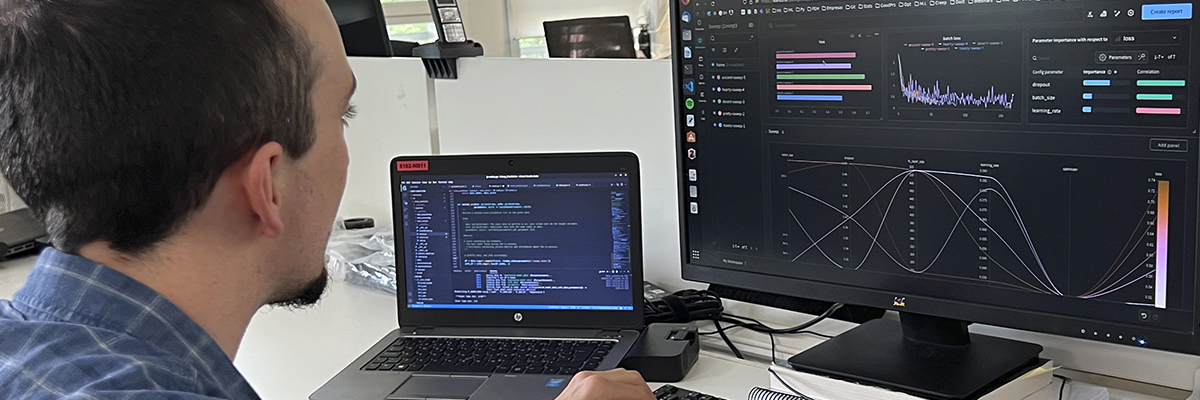
Alongside this, we are conducting research to understand and model the mechanical behaviour of TPEs by combining deep neural network or Deep Learning techniques based on physics and traditional simulation methods, such as the finite element method, which allows us to predict the behaviour of real materials and parts more accurately and quickly.
Neural networks are a sub-field of machine learning and artificial intelligence, capable of learning complex patterns and extracting relevant information from large data sets. However, these data-driven networks are data-intensive and their generalisability is limited, i.e. predictions cannot be trusted when the input data is different from the training data, and often the predictions do not adhere to the physical principles that govern the behaviour of the materials. Adapting models to conform to these principles reduces the amount of data required, improves generalisability, and models converge more efficiently.
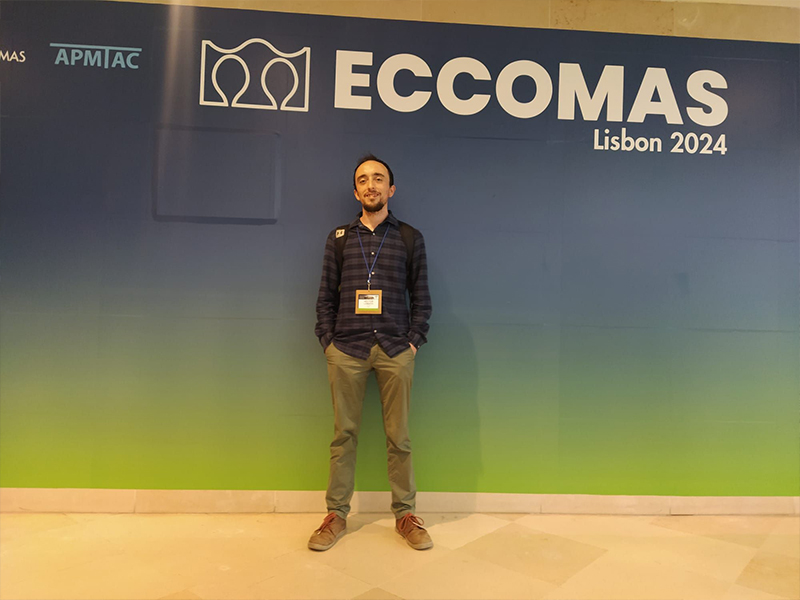
Therefore, we are currently working on studying the applicability of different hyperelastic constitutive models based on physics-informed neural networks for modelling the hyperelastic behaviour of TPVs. TPVs are thermoplastic vulcanizates, a type of high-performance thermoplastic elastomer (TPE) with good dynamic properties, making them a more sustainable alternative to traditional rubber and elastomers. We presented these results at the European Conference on Computational Methods in Applied Sciences and Engineering (ECCOMAS).
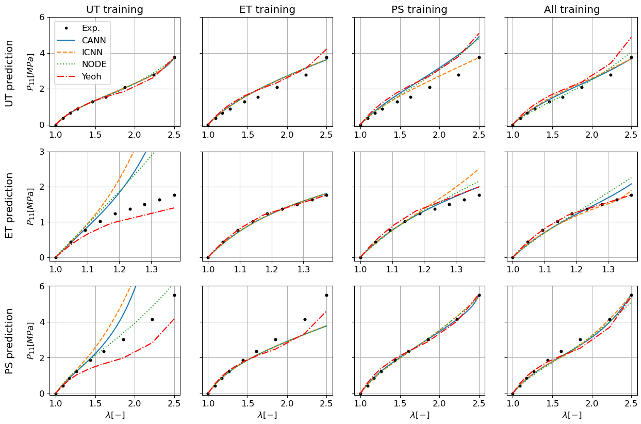
The image shows the fits of various neural network-based constitutive models (CANN, ICNN and NODE) and of a traditional constitutive model (Yeoh) to tensile test curves in different modes of deformation. The first three columns show the ability of the models to extrapolate from one mode to another (which is limited above a certain range of deformation), while the right-hand column shows that the quality of the fits is better when the models are trained with all the data.
Modelling the non-linear mechanical behaviour of materials with neural networks is an emerging field of research with huge potential, allowing us to create accurate material models and automate the whole modelling process, from obtaining test data to implementing these models in finite element packages.
At the forefront of characterisation
At Leartiker we conduct research in these fields, generating knowledge to predict the long-term behaviour of polymeric materials, and for this we rely on 4 key pillars:
- Running standardised tests to produce material data sheets (ISO 899, ASTM D2990, etc.), and also to validate other (accelerated) methods.
- Conducting accelerated tests (time-temperature superposition, time-stress, accelerated creep to failure tests, etc.) to reduce material and product testing times.
- Fitting to experimental data through physically meaningful models (empirical, full constitutive models, etc.) and running finite element simulations.
- Using AI tools (machine learning, databases, etc.) to digitally predict long-term behaviours by reducing or eliminating the need to run tests.





 info@leartiker.com