Promoting the second life of batteries and industrial digitalisation through the REVIA project
The Leartiker technology centre is participating in the REVIA collaborative initiative, which aims to experimentally develop state-of-the-art technological solutions to improve the performance, safety, efficiency and sustainability of second-life batteries for light electric vehicles, using an industrial plant as the validation environment.
REVIA takes a comprehensive approach to the technological, industrial and regulatory challenges associated with battery reuse, with a particular focus on the circular economy, process digitalisation and traceability via digital passports.
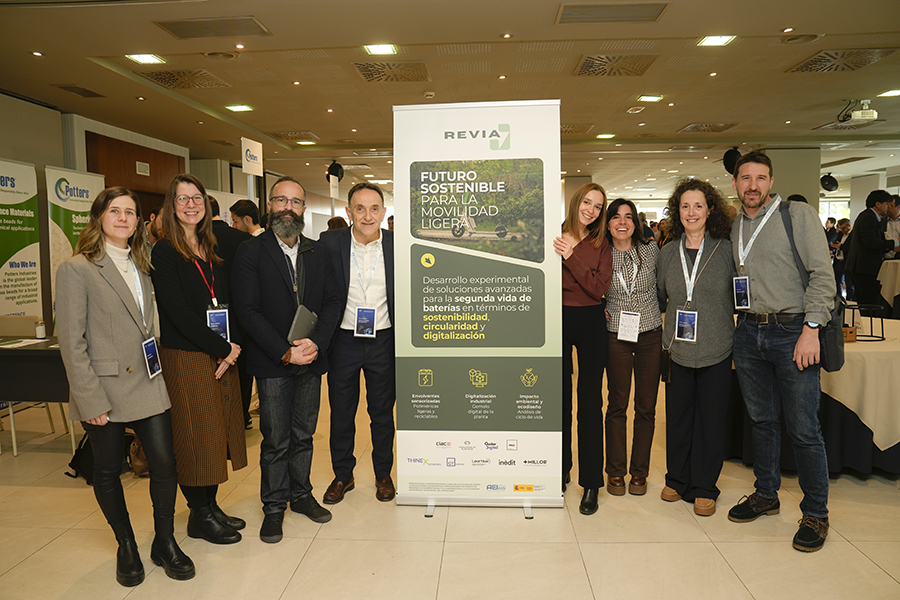
A multidisciplinary consortium for a strategic challenge
The initiative involves a multidisciplinary consortium coordinated by CIAC –the Automotive Industry Cluster of Catalonia– with the participation of the Digital Cluster of Catalonia, the Spanish Plastics Centre (CEP) and the MAV Cluster – Advanced Materials of Catalonia. The technological development is being carried out in collaboration with the SMEs Leartiker, Rotimpres, Cadtech Solutions and Inèdit, structured around the real industrial environment of MillorBattery, a battery manufacturer acting as a demonstration company.
REVIA is based around two main pillars. Firstly, the development of lightweight polymer casings with integrated thermal and sensing functionalities, incorporating flame-retardant properties, passive thermal management and printed sensors to improve the safety and efficiency of battery modules, both for first-life applications and for potential second-life applications. Secondly, the optimisation of logistics and production processes at the Millor Battery plant through the development of a digital twin capable of analysing scenarios, reducing scrap, anticipating bottlenecks and facilitating simulation-based operational decision-making.
Leartiker at REVIA
Leartiker’s role within this initiative focuses on the development of new advanced polymeric materials to be used in the manufacture of prototype battery casings and enclosures. Furthermore, Leartiker will be responsible for the functional integration of printed sensors into the prototypes, thereby ensuring compatibility between the polymeric substrate and the embedded sensors or heaters.
The polymeric materials developed for this purpose will be thermoplastic composites with high mechanical strength and low density, which will include flame-retardant properties.
Expected results
REVIA aims to achieve a weight reduction of between 30% and 50% in battery casings through the use of advanced polymeric materials. A significant improvement in safety and thermal stability is also expected thanks to the integration of sensing technologies and passive thermal management systems.
From a production perspective, the digital twin will help reduce scrap, improve operational efficiency and decrease downtime through the evaluation of virtual scenarios. At the same time, the integration of circular economy and eco-design criteria will contribute to a measurable reduction in the environmental impacts associated with the life cycle of the batteries developed.
At Leartiker, we work to drive a more innovative, resilient and sustainable industry, supporting companies in the transformation of their processes and products through scientific and technological expertise. As with the REVIA project, we are committed to generating solutions that bring real value to the industrial sector, promoting models that are more efficient and environmentally responsible.
Project funded by the Ministry of Industry and Tourism under the 2025 call for applications for grants to support Innovative Business Groups, with the aim of enhancing their competitiveness and their contribution to strategic autonomy. REVIA – Reference number: AEI-010700-2025-1






 info@leartiker.com